
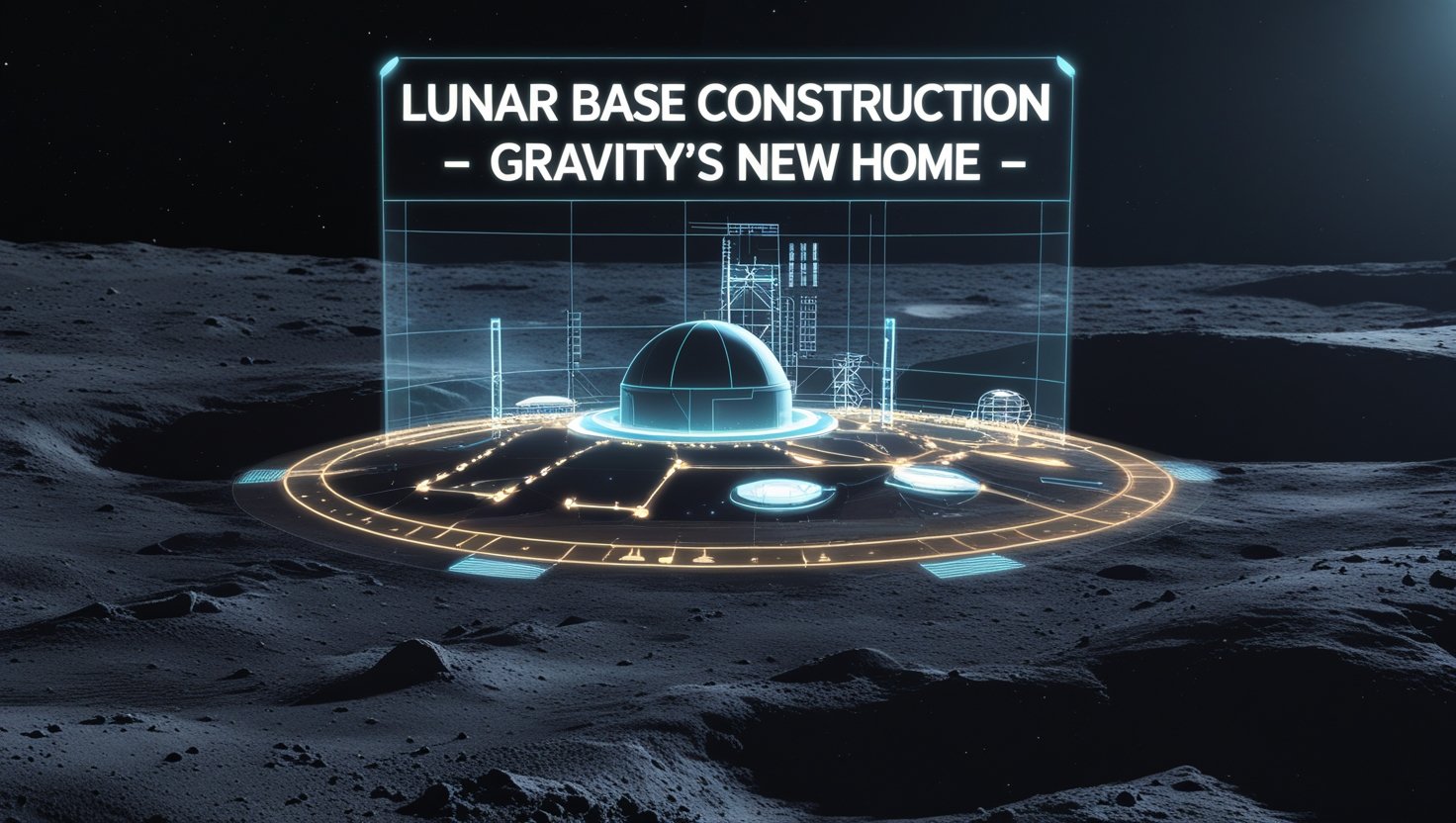
Imagine humanity building a new home on the Moon, a place where every dawn is defined by new horizons and every step redefines our limits. Lunar Base Construction offers us a glimpse into a future where space is not just a destination but a vibrant habitat. This venture into “Gravity’s New Home” unites innovation, sustainability, and bold ambition in one groundbreaking mission.
Pioneering Beyond Earth:
The vision behind establishing a lunar base goes far beyond terraforming space; it’s about transforming the Moon into a launchpad for future exploration. This initiative reimagines human life off Earth by creating permanent habitats on the lunar surface. The idea is to establish structures that are not only safe havens but also robust research centers, gateways for deeper space missions, and hubs for innovating new technologies.
With a focus on Lunar Base Construction, scientists and engineers are working to create designs that can withstand the harsh lunar environment while promoting long-term human habitation. This pioneering project fuels our collective imagination and challenges us to harness technology and ingenuity to create a second home where gravity is redefined, a home that blends scientific progress with the human desire to explore and live among the stars.
Engineering on the Moon:
Designing infrastructure on the Moon poses unique engineering challenges. Unlike Earth, the Moon’s surface is marked by a near-vacuum environment, extreme temperature fluctuations, and significantly reduced gravity. These conditions necessitate innovative building methods and materials that can endure radiation, micrometeorite impacts, and thermal stresses. Engineers are now testing hybrid construction techniques, from inflatable modules to permanent structures made with advanced composites, to ensure the safety and durability of a lunar base.
By leveraging the reduced gravity, construction equipment can be lighter and possibly more energy-efficient, yet designers must also counterbalance the lack of atmospheric pressure that can affect material behavior over time. These efforts in Lunar Base Construction are paving the way to overcome extraterrestrial challenges and ensuring that our first steps on the Moon will be as structurally sound as they are visionary.
Raw Materials in Lunar Construction:
One of the most exciting aspects of building on the Moon is the potential to use local resources. Lunar regolith, the layer of loose, fragmented material covering solid rock, can be repurposed as a primary construction material. Innovations in 3D-printing technology now offer the possibility to transform this abundant resource into durable building blocks, reducing the dependence on Earth-supplied materials.
The process involves heating, melting, or chemically binding the regolith to form solid components that could be used for walls, floors, or even entire structures. This approach not only promotes sustainability but also significantly cuts down on transport costs and logistical challenges. Embracing the potential of local resources is crucial for establishing “Gravity’s New Home” and represents a harmonious blend of environmental adaptation and technological prowess in Lunar Base Construction.
Life on the Lunar Surface:
Creating a livable habitat on the Moon extends far beyond structural integrity; it also requires a comprehensive strategy for human survival. The design of lunar habitats must integrate robust life support systems capable of generating breathable air, recycling water, and managing waste, all within a closed-loop ecosystem. Architects and engineers are exploring concepts such as modular dwellings with adaptable living spaces that can expand as more colonists arrive, as well as smart systems that monitor environmental conditions in real time.
Psychological well-being is another critical aspect: living in confined, isolated conditions demands a design that incorporates communal areas, natural light simulation, and recreational spaces to ensure mental health. Successfully merging these elements will make lunar habitats comfortable and sustainable, truly transforming the notion of “Gravity’s New Home” into a thriving human community.
Powering Gravity’s New Home:
Energy generation on the Moon must rely on self-sufficient and renewable solutions. Given the abundance of sunlight on the lunar surface, solar power is a natural key to powering a lunar outpost. Advanced photovoltaic panels, equipped to withstand the Moon’s harsh conditions, could provide a steady stream of energy essential for life support systems, scientific instruments, and construction operations.
Other potential energy sources include small nuclear reactors designed for long-duration missions, offering a backup during periods when solar energy production is compromised by lunar nights or dust accumulation. Integrating these renewable energy solutions ensures that the lunar base remains fully operational and independent, a crucial aspect of Lunar Base Construction that emphasizes sustainability and resilience in the creation of our new extraterrestrial habitat.
The Robotic Renaissance:
The role of robotics and artificial intelligence is central to the success of building on the Moon. Autonomous rovers, drones, and robotic arms are being designed to perform tasks that are either too dangerous or incredibly laborious for human workers. These machines can survey the lunar landscape, transport materials, and even perform intricate construction tasks under remote human supervision. By harnessing AI, these robots learn to adapt to unpredictable conditions and optimize their performance over time.
Automation not only accelerates the construction process but also minimizes risks associated with manual labor in a hostile environment. This robotic renaissance provides the backbone for sustainable, efficient Lunar Base Construction, ensuring that every brick laid and every structure erected on the lunar surface contributes to a secure, scalable, and self-reliant habitat.
Designing Self-Sufficiency:
A sustainable lunar base must be self-sufficient, with systems that support continual recycling and resource regeneration. Closed-loop life support systems are being designed to recycle water, convert carbon dioxide into oxygen, and process organic waste into usable soil for potential lunar agriculture. Innovations in bioreactor technology offer the promise of growing food in controlled environments, reducing reliance on supply missions from Earth. Furthermore, waste generated by daily activities can be repurposed to generate energy or serve as raw materials for further construction.
The aim is to create a miniature ecosystem where every output becomes an input, mirroring the natural cycles that sustain life on Earth. This innovative approach not only ensures the longevity of the lunar settlement but also embodies the principles of eco-friendly design and sustainability, making it a core tenet of “Gravity’s New Home”.
Lessons from Earth:
While the lunar environment presents its own set of challenges, many lessons learned from Earth-based sustainable architecture offer valuable insights. Concepts such as green building, energy-efficient design, and resilient infrastructure can be adapted to suit the unique demands of space habitation. For example, techniques like passive solar design, thermal mass management, and the use of smart materials can be optimized for a lunar setting to mitigate extreme temperature variations.
Engineers can also draw upon decades of experience in remote and harsh environments, like Arctic research stations, to devise strategies for maintaining habitability under severe conditions. By combining terrestrial innovations with cutting-edge extraterrestrial technology, Lunar Base Construction can create habitats that are not only resilient but also inherently adaptive, transforming the Moon into a comfortable extension of Earth’s living space.
Expanding the Horizon:
The establishment of a lunar base is only the first step toward a broader human presence in space. This pioneering effort will serve as a testbed for technologies and systems that could be scaled up for missions to Mars and beyond. A self-sustaining lunar outpost would provide invaluable experience in off-world living, logistics, and resource management, laying the groundwork for further exploration of our solar system.
The data gathered from daily operations, environmental monitoring, and human performance in space will inform future missions and help refine strategies for deep space colonization. Each milestone in setting up “Gravity’s New Home” will propel humanity closer to becoming an interplanetary species. The ripple effects of successful Lunar Base Construction extend far beyond the Moon, opening up vast possibilities for scientific discovery, technological advancement, and a new era of space exploration.
A Global Effort:
Building a permanent presence on the Moon is too monumental a task for any single nation to undertake alone. The effort calls for global collaboration, where international space agencies, private companies, and research institutions come together with a shared vision. Partnerships between organizations like NASA, ESA, Roscosmos, and emerging space enterprises are forging a cooperative framework that leverages the unique strengths and expertise of each contributor. These collaborations are marked not only by resource sharing but also by a collective commitment to standards, safety, and sustainability.
By pooling knowledge, technology, and financial resources, the international community can accelerate the process of Lunar Base Construction and ensure that the resulting habitat is a symbol of unity and human achievement. This unified approach echoes the sentiment of “Gravity’s New Home” as a beacon of hope and progress for all of humankind.
Conclusion:
Lunar Base Construction represents humanity’s bold leap into a new frontier. With innovative engineering, sustainable resource management, and global collaboration, we are on the cusp of turning the Moon into a self-sufficient habitat, a true Gravity’s New Home. This venture not only challenges our technological limits but also redefines our place in the universe. As we continue to learn, adapt, and innovate, our lunar foothold will pave the way for a future where space is home, and the stars are within reach.
FAQs;
Q1: What is Lunar Base Construction?
It’s the process of building a permanent human habitat on the Moon.
Q2: Why build on the Moon?
The Moon serves as a launchpad for further space exploration and offers unique research opportunities.
Q3: How will structures on the Moon be built?
Using advanced techniques like 3D printing with lunar regolith and robotic automation.
Q4: What are the main challenges?
Extreme temperatures, radiation, and reduced gravity.
Q5: Can the Moon support human life?
With proper life support, energy, and recycling systems, a sustainable habitat is possible.
Q6: How does this benefit future space missions?
A lunar base is a stepping stone for longer missions to Mars and beyond.